

Who is Eligible
Residential properties are defined as any property on which a single-family, duplex, or townhome dwelling exists and is used for noncommercial purposes. Below are the Stormwater Utility Fee Credit Manual, credit application forms and appendix documents you will need to complete a Residential Credit Application.
- Apply for a Credit
Online Application option
Fillable PDF Application option [327KB]
- Related Resources
- Stormwater Fee Petition Form (For issues with Stormwater Assessment) [654.1KB]
- Residential Program Manual [5.7MB]
- Renewal Process
Re-apply for credit after 5 years of receiving your approval letter.
Best Management Practices (BMPs) Eligible for Credit
- Roof Drain Disconnection
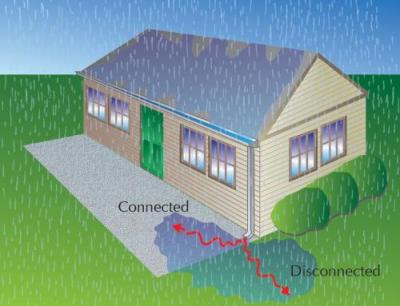
Half of the roof downspouts lead to pervious vegetated area - 10% Credit
All roof downspouts lead to pervious vegetated area - 20% Credit
Rooftop disconnections must be inspected to ensure that they operate in good working condition and in accordance with the approved design and specifications. Items in need of repair must be immediately addressed.
Routine Maintenance Tasks Frequency Remove trash and debris As needed Check and repair eroded areas Annually Inspect for downspout disconnection Annually Inspect for and remove any sediment accumulation Annually Check that pervious areas receiving flow have not been disturbed or converted Annually - Rain Barrel/Cistern
Roof downspout(s) leads to at least one rain barrel/cistern - 20% Credit
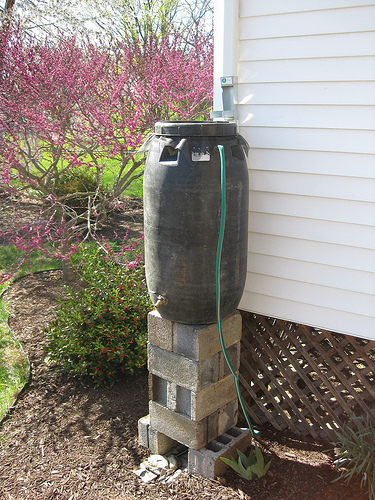
Rain barrels and cisterns must be inspected to ensure they operate in good working condition and in accordance with the approved design and specifications. Items in need of repair must be immediately addressed. All rain barrel and cistern components should be inspected by the homeowner twice per year.
Routine Maintenance Tasks Frequency Remove leaves and debris from gutters and downspouts Semi-annually Remove any algae growth Semi-annually Inspect and clean prescreening devices and first flush diverters Quarterly Inspect and clean storage tank lids Annually Inspect for and repair any clogging Annually Inspect and repair mosquito screens Annually Inspect tank and remove sediment build up Every 3 year Clear overhanging vegetation and trees over roof Every 3 year Check integrity of backflow preventer Every 3 year Inspect structural integrity of tank, pump, pipe, and electrical system and repair any damage Every 3 year Replace damaged or defective system components As needed - Conservation Landscaping
Dense, native vegetation covers at least 20% of property - 10% Credit
First Year Maintenance Guidelines Successful establishment of conservation landscaped areas requires that the following tasks be undertaken in the first year following installation:
- Watering. Watering is needed once a week during the first 2 months, and then as needed during first growing season (April-October), depending on rainfall.
- Remove and replace dead plants.
Routine Maintenance Guidelines Conservation landscaped areas must be inspected to ensure good health of plants.
Routine Maintenance Tasks Frequency Remove trash and debris As needed Check and repair eroded areas Annually Weed mulch Twice during the growing season Inspect plant composition for consistency with approved plans and correct any deficiencies Annually Re-mulch to maintain a 2–3-inch layer Annually Prune trees and shrubs Annually Remove invasive plants As needed Replace dead or damaged plant material As needed - Tree Planting/Tree Cover
New or existing tree covers 20% of property for properties 2.5 acres or less. For properties 2.5 acres or more, tree canopy must cover 10% of entire property - 10% Credit
For Newly Planted Trees - First Year Maintenance Guidelines: Successful establishment of trees requires that the following tasks be undertaken in the first year following installation:
- Watering. Deep water regularly throughout the first growing season. Allow water to run slowly, soaking the soil, once or twice a week. Water at the perimeter or edge of the planting site.
- Remove Stakes and Strapping after 1 year unless site is extremely windy. Do not stake longer than 2 years. Remove tree tubes when trees reach about 3-inches in diameter at the base.
- Keep grass and weeds out of mulched area.
Routine Maintenance Tasks Frequency Inspect and replace mulch as needed Annually Weed mulch Twice during the growing season Prune trees Annually Inspect tree health and correct any deficiencies Annually - Homeowner Nutrient Management and Lawn Care Agreement
Maintaining a good vegetative lawn without the use of nutrients or with strategies to reduce nutrients 10% Homeowner Nutrient Management and Lawn-care Agreement [1.4 MB]
- Rain Garden
Roof downspout(s) lead to shallow depression designed to temporarily hold water to allow it to infiltrate into the ground - 20-25% Credit
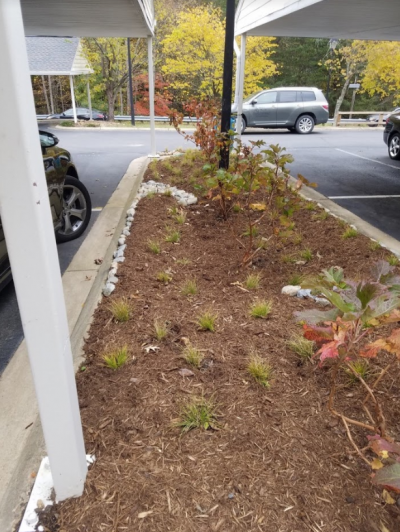
Rain Garden photo from VASWCD.org/rain-garden First Year Maintenance Guidelines Successful establishment of rain garden areas requires that the following tasks be undertaken in the first year following installation:
- Initial inspections. For the first 6 months following construction, the rain garden area should be inspected at least twice after storm events that exceed 1/2 inch of rainfall.
- Spot reseeding. Inspect for bare or eroding areas in the contributing drainage area or around the rain garden area, and make sure they are immediately stabilized with grass cover.
- Watering. Watering is needed once a week during the first 2 months, and then as needed during first growing season (April-October), depending on rainfall.
- Remove and replace dead plants
Routine Maintenance Guidelines: Rain garden areas must be inspected to ensure that they operate in good working condition and in accordance with the approved design and specifications. Items in need of repair must be immediately addressed.
Routine Maintenance Tasks Frequency Remove trash and debris As needed Check and repair eroded areas Annually Inspect for and remove excess sediment Annually Weed mulch Twice during the growing season Inspect plant composition for consistency with approved plans and correct any deficiencies Annually Remulch to maintain a 2-3 inch layer Annually Prune trees and shrubs Annually Inspect for clogging or ponding water in the filter bed Annually Remove invasive plants As needed Replace dead or damaged plant material As needed Repair broken pipes As needed Replace the mulch layer Every 3 years - Impervious Cover Removal
Removal of impervious surfaces like sidewalks and driveways or additions of permeable hardscapes and vegetated roofs Removes sq ft from billing area - Septic Connection to Public Sewer Credit
Connecting from a septic system to the sanitary sewer system since 2006 - 10-50% Credit